| Drug Name |
Escitalopram |
| Drug ID |
BADD_D00809 |
| Description |
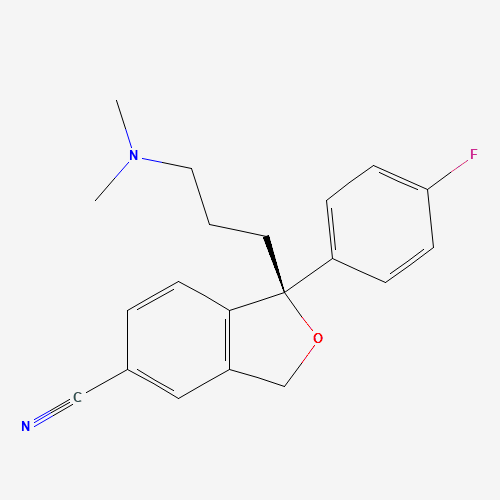
Escitalopram is a selective serotonin re-uptake inhibitor (SSRI) and the S-enantiomer of racemic [citalopram].[A185420] It is used to restore serotonergic function in the treatment of depression and anxiety.[L8513,L8516,L8522] Escitalopram is approximately 150 times more potent than citalopram’s R-enantiomer and is responsible for the vast majority of citalopram’s clinical activity, with some evidence suggesting that the R-enantiomer of racemic citalopram actively dampens the activity of escitalopram rather than existing simply as an inactive enantiomer.[A39738,A185819] Amongst SSRIs, escitalopram exerts the highest degree of selectivity for the serotonin transporter (SERT) relative to other off-targets which may explain its lower rates of adverse effects as compared to other agents in this class.[A185726] Escitalopram also differentiates itself from other SSRIs via allosteric action on its target - this may be the mechanism responsible for its observed superior efficacy and faster onset compared to other SSRIs.[A185825,A185726,A185822] |
| Indications and Usage |
Escitalopram is indicated for both acute and maintenance treatment of major depressive disorder (MDD) and for the acute treatment of generalized anxiety disorder (GAD).[L8513] It is additionally indicated for symptomatic relief of obsessive-compulsive disorder (OCD) in Canada.[L8516] |
| Marketing Status |
approved |
| ATC Code |
N06AB10 |
| DrugBank ID |
DB01175
|
| KEGG ID |
D07913
|
| MeSH ID |
D000089983
|
| PubChem ID |
146570
|
| TTD Drug ID |
D08RBC
|
| NDC Product Code |
80425-0320; 50090-4915; 51655-284; 53002-1431; 67296-1200; 0456-2010; 0456-2020; 69097-848; 70518-1785; 71335-1030; 0615-8366; 42708-163; 45865-699; 55700-847; 69844-079; 72189-424; 72189-451; 16729-168; 43547-281; 43547-282; 61919-652; 63187-281; 68001-456; 68071-5248; 68788-7461; 69844-077; 70934-630; 68001-454; 68071-2035; 68645-520; 68788-7510; 69844-078; 70934-957; 71205-344; 71610-425; 71610-534; 72189-449; 16571-755; 16729-170; 50090-2196; 51655-236; 53002-2438; 60760-393; 68788-7912; 70518-2317; 70771-1145; 71335-1002; 71335-1187; 71335-1307; 16571-757; 51655-766; 54838-551; 70518-2430; 70771-1147; 50090-4363; 50090-5312; 50090-6534; 51655-116; 51655-149; 69097-847; 69097-849; 70518-1876; 71205-325; 76282-250; 76282-251; 42708-155; 50090-1930; 70518-2472; 70518-3151; 70771-1146; 82982-030; 43547-280; 50090-6190; 51655-277; 55700-818; 63187-217; 67296-1597; 68001-455; 68645-519; 0456-2005; 70518-1805; 70518-2597; 71335-1571; 72189-438; 0615-8365; 72789-194; 76282-249; 16571-756; 33342-053; 60760-170; 65162-705; 71205-782; 71335-1241; 71335-2058; 0615-8348; 16729-169; 43063-661 |
| UNII |
4O4S742ANY
|
| Synonyms |
Escitalopram | Escitalopram Oxalate | Lexapro |